



There comes a moment in life when you realize that you don’t actually want more noise. All you want is
- More clarity.
- More direction.
- More intention in how you live, grow, and choose your next steps.
Personal growth is not about becoming someone else. It is about developing into the person you dream of becoming —more aware, more grounded, and more purposeful. Yet the majority of us struggle not because we lack motivation, but because we lack structure. We want to grow, but we don’t know where to begin.
That is where a personal growth plan template becomes powerful. It’s not a rigid system, but a gentle framework that helps you organize your thoughts, identify what truly matters in your life, and take small but meaningful steps toward the life you want to live.
In this guide, I’ll walk you through a simple, but practical personal growth plan template you can adapt to your own journey—whether you are navigating career decisions, relationships, identity, or personal development as a whole.
Or whether, just like me, you’re navigating motherhood, career, business, being a wife, and managing a home. Navigating these aspects of your life and craving for more growth and development because you don’t want to be stagnant can be tough, exhausting, and stressful.
Sometimes you feel stuck, slow, and wonder if you’ll ever make any progress for yourself. But personal growth is imperative for every human because it transforms you into your ultimate self. Having a personal growth plan ensures that you’re constantly working on yourself to improve.
What Is a Personal Growth Plan?
A personal growth plan is a written roadmap for improving yourself intentionally. It helps you clarify where you are now, where you want to go, and what habits, skills, or mindset shifts will support that journey.
It is not about perfection; It is about direction. Think of it as a mirror and a compass combined:
- A mirror, because it invites honest self-reflection.
- A compass, because it guides you when life feels overwhelming.
When done well, a personal growth plan does not pressure you to change everything at once. Instead, it focuses on progress—small, consistent improvements that align with your values and long-term vision.
Why You Need a Personal Growth Plan

Intentionality matters. Without you being intentional, growth becomes accidental. You may move forward in some areas, stay stagnant in others, and never fully understand why.
Here is what a structured personal growth plan helps you do:
- Clarify your priorities instead of chasing every new idea.
- Track your progress so growth becomes visible, not abstract.
- Make better decisions by understanding your goals.
- Build consistency instead of relying solely on motivation.
Most importantly, it allows you to grow in a way that feels aligned with your life—not forced or borrowed from someone else’s life.
For me, getting my master’s degree was intentional. I was a new mom with a three-month-old baby, but I wanted to use that period to upgrade my certificate and elevate my life. It was not easy, but I was intentional and determined to get it, and I succeeded.
The Simple Personal Growth Plan Template
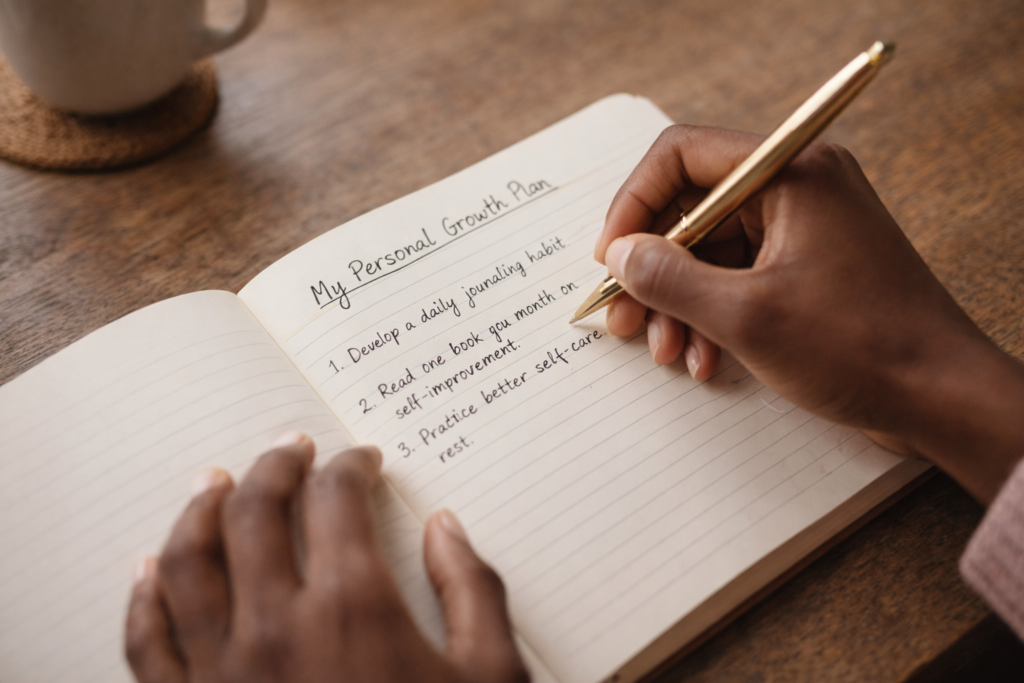
This template is intentionally flexible. You can use it digitally, in a notebook, or as a printed worksheet. What matters is that you engage with it honestly. Below are the six core sections that form your personal growth plan template.
1. Self-Reflection: Where Am I Right Now?
Every meaningful change begins with awareness. Before setting your goals, pause and ask yourself:
- What areas of my life feel aligned?
- Where do I feel restless, stuck, or dissatisfied?
- What patterns keep repeating or procrastinating about?
Break your life into a few key categories:
- Personal mindset
- Career or purpose
- Relationships
- Health and well-being
- Finances
- Creativity or self-expression
For each category, write one or two honest observations.
For example:
- “I feel capable at work, but disconnected from meaning and satisfaction.”
- “I prioritize others but rarely make space for myself.”
This is not a space for judgment. It is simply a space for truth. So, be honest with yourself by being transparent and truthful in what you write down.
This is what I wrote down for myself when I was getting my master’s, “I have to get this master’s because I don’t want to spend a whole year only taking care of my baby and acheiving nothing else. If not anything, I should have a baby and something that puts me ahead of my colleagues.”
And yes, I wrote that down. That alone motivated me to finish it.
2. Vision: Where Do I Want to Grow?
Growth becomes powerful when it is connected to a deeper vision. Ask yourself:
- What kind of person am I becoming?
- How do I want my life to feel in the next year?
- What values do I want to embody more fully?
Instead of vague ideas like “be better” or “be successful,” aim for clarity:
- “I want to become emotionally resilient.”
- “I want to feel confident in my purpose.”
- “I want my relationships to be healthier and more honest.”
Your vision does not have to be dramatic. It just has to be true.
3. Goals: What Am I Working Toward?
This is where your personal growth plan becomes actionable. Choose 1–3 growth goals for the next 3–6 months. Keep them focused and meaningful.
Examples: in 3 or 6 months I want to:
- Develop a consistent self-reflection habit.
- Improve communication in relationships.
- Build discipline in my daily routines.
- Gain clarity in my career direction.
For each goal, answer:
- Why does this matter to me? Maybe to get a promotion at work.
- How will my life improve if I achieve it? Maybe earn a better income.
This ensures your goals are not based on pressure or comparison, but on personal meaning.
4. Action Steps: How Will I Grow?
Goals only become real through daily choices. For each goal, you can list simple, repeatable actions. These should be practical enough to fit into your current life.
Example:
Goal: Improve emotional awareness
Actions:
- Journal twice a week.
- Reflect after difficult conversations.
- Read one book on emotional intelligence this month.
Another Example is:
Goal: Gain clarity in purpose by understanding who you truly are or what you want to become.
Actions:
- Schedule one weekly thinking session.
- Write about what energizes me.
- Have one intentional conversation with a mentor.
You need to understand that growth is not built in dramatic moments; it is built in ordinary days.
So, for me to pass my exams, I scheduled a timetable to study while taking care of my baby. I did that in between the baby’s naps and feeds.
5. Accountability: How Will I Stay Consistent?
Motivation will fade. It’s only the systems you put in place that will remain.
Decide in advance:
- How will I track progress?
- Who or what will keep me accountable?
You might:
- Review your plan every Sunday.
- Use a journal or habit tracker.
- Set monthly check-in reminders.
- Share your goals with a trusted person.
Accountability is not about pressure; it is about presence. It keeps your growth visible when life becomes busy.
6. Reflection: What Am I Learning About Myself?
Growth is not linear. Some weeks you will feel confident. Other weeks, you will feel uncertain again. That does not mean you are failing. It means you are becoming more self-aware.
Schedule regular reflection:
- What is working?
- What feels forced or unrealistic?
- What have I learned about myself this month?
Your personal growth plan should evolve as you evolve. You’re going to doubt yourself and your capabilities. But just before you give up, know that you’re very close to your transformation.
A Sample Personal Growth Plan Template

Here is a simple structure you can copy into your journal or document and fill out.
Current Reality:
Where am I now in my life?
Growth Vision:
Who I want to become and how I want my life to feel.
Main Growth Goal (Next 3–6 Months):
My primary focus for personal development.
Supporting Actions:
Small habits and practices that move me forward.
Accountability Method:
How will I track and review my progress?
Reflection Space:
Lessons, adjustments, and insights along the way.
This template is not meant to control your life; it is meant to guide it.
Common Mistakes in Personal Growth Planning
Even with a solid template, growth can stall if certain traps appear.
1. Trying to Change Everything at Once
Growth is sustainable when it is focused. You only have to choose a few meaningful areas rather than overwhelming yourself. This is not a race nor a competition for yourself.
2. Copying Someone Else’s Path
Your life, responsibilities, and values are unique. So, make sure your personal growth plan reflects that. Don’t erase yourself by copying someone’s life entirely.
3. Ignoring Emotional and Mental Growth
Growth is not only about productivity or achievement. Inner clarity matters just as much as external success. Master emotional intelligence and tenacity.
4. Quitting When Motivation Fades
I’ve quit on so many occasions, but this is what I have learned: Progress is built on consistency, not inspiration. One moment you’re inspired, and the next minute you feel burdened.
How This Fits Into Real Life
Personal growth is not a separate project. It is woven into your everyday choices:
- How you respond to challenges
- How you speak to yourself
- How you set boundaries
- How you pursue what matters
A personal growth plan does not demand a new life. It asks you to live your current life with more awareness.
Why Personal Growth Is a Lifelong Process

Growth does not end when you reach a milestone. Each stage of life asks new questions of you:
- Who am I becoming now?
- What no longer fits?
- What am I being invited to learn?
Your personal growth plan will change as your seasons change. That is not inconsistency—it is maturity.
Personal growth plan template is not about becoming “better.”
A personal growth plan template is not about becoming “better” in the eyes of others. It is about becoming more honest with yourself. More intentional. More aligned.
You do not need a perfect plan. You need a sincere one. If you are willing to reflect, to take small steps, and to remain open to learning about yourself, growth will follow—quietly, steadily, and meaningfully.
And sometimes, the most powerful transformation is not in how far you go, but in how deeply you begin to understand who you already are.